


Sub-Grant: Promotion of Tourism Service Providers Along The Palestinian Heritage Trail
Palestinian Heritage Trail (PHT)
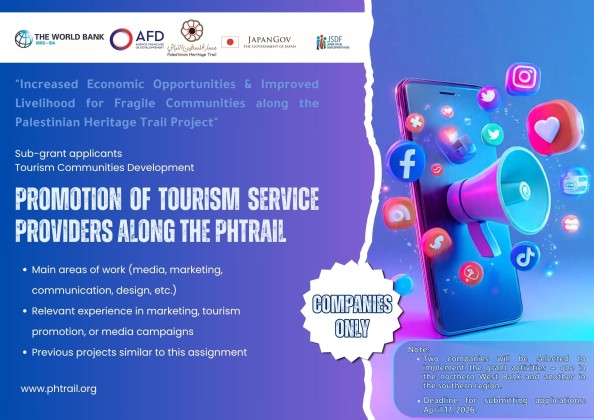
Increased Economic Opportunities and Improved Livelihood for Fragile Communities along the Palestinian Heritage Trail
(PH Trail) in The West Bank
Financed by :the government of Japan Funded through the JSDF and the World Bank
Guidelines for sub-grant applicants
Tourism Communities Development
Promotion of Tourism Service Providers and communities along the PH Trail
Reference: Call for sub-grant proposals No. 4 in Palestine -PHT
Deadline for submission of application: 17/4/2026
1.1. Background
Palestinian Heritage Trail (PHT) is a non-profit community-based tourism union that delineates and develops PH Trail in and around different Palestinian localities. https://phtrail.org
Palestinian Heritage Trail (PH Trail) is a long-distance cultural hiking route in Palestine that was developed by PHT the organization in cooperation with the local communities. The trail is about 500 km long and trail passes through more than 90 Palestinian cities, villages and local communities where hikers can experience and enjoy authentic Palestinian Hospitality.
In 2022, PHT received a grant supported by the government of Japan Funded through the JSDF and the World Bank to implement “Increased Economic Opportunities and Improved Livelihood for Fragile Communities along the Palestinian Heritage Trail (PH Trail) in the West Bank” project. The objective of this project is to benefit about 2,700 Palestinian individuals present in about 50 fragile communities along the Palestinian Heritage Trail across the West Bank. There will be a special focus on women and youth, as it is estimated that at least 40% of the beneficiaries will be women and 25% youth.
1.2. Objectives of the call for sub-grants
The objective of this call for sub-grant proposals is to support media and communication companies to work with tourism service providers and communities along the PH Trail, such as handicraft producers, agritourism sites, rest areas, and other local businesses in developing promotional materials and marketing tools. The call also aims to promote local products and highlight the communities where they are produced, strengthen their linkage to these communities, and clearly showcase their locations along the trail.
The selected companies will assess the promotional needs of these service providers and help them develop promotional materials and marketing tools to increase local awareness and demand for their services, especially in light of the current absence of tourism.
Financial allocation
Size of the sub-grants
Any grant requested under this call for proposals must not exceed the maximum amount of USD 20,000.
Applicants must provide a minimum co-financing contribution of 20%.
Beneficiary Contribution
The beneficiary is required to provide a minimum 20% contribution to the total cost. This contribution may include:
- Coordination costs: A percentage of the coordinator’s time is dedicated to the grant activities; therefore, the proportional share of their salary is budgeted under the project and accounted for as a contribution
- A financial contribution toward the total cost of the equipment
- Production of additional media materials or output
1.3. Eligibility criteria
1.3.1. Eligibility of applicants
Eligible beneficiaries of the grant’s media and communication firms
1.3.2. Eligible actions: actions for which an application may be made
Definition
Matching grant is composed of a set of activities.
Duration
The planned duration of the matching grant may not exceed 4-5 months after signing the sub-grant contract.
Sectors or themes
Community-based tourism
Location
Location:
Two media and communication companies will be selected:
- One operating in the Northern West Bank
- One operating in the Southern West Bank
- Goods and services for activities that are already completed. The activities and their costs need to occur during the grant implementation. In other words, no retroactive activity will be financed by the matching grants.
Types of action
Types of Matching grant that may be financed under this call are the actions that are directly contributing to the achievement of the objectives as per section 1.2 above.
The goods and services that are eligible for financing with matching grants, together with recommended financing thresholds (including the limit for each grant beneficiary and the amount of co-financing required), are identified in the sections on each sub-component which can be found below.
Exclusion List for Goods and Services
The following list represents goods and services that are non-eligible for any matching grants:
- activities which are likely to have significant adverse social and environmental impacts.
- Sub-sub granting (the Sub-Grant recipient cannot use the Sub-Grants for further financing to other beneficiaries).
- debt and debt service charges.
- interest owed.
- currency exchange losses, fees, and penalties.
- payments to the public institution’s employees.
- any other costs which could have been specified as ineligible in the calls for proposals.
Types of activity
Eligible Activities
The following activities may be supported under this announcement:
- Equipment and Tools (up to 10% of the total grant value)
The purchase of essential equipment and tools that enhance the quality, efficiency, and technical capacity of the media company to deliver high-quality media and communication services. - Production of Promotional Media Content (up to 80% of the total grant value)
The development and production of at least 1–2 promotional media materials aimed at promoting the grants listed in Annex 1. These materials may include, but are not limited to:- Short promotional videos or reels
- Sponsored social media posts and campaigns
- Visual identity and branding materials
- Documentation of Service Providers (up to 10% of the total grant value)
- Collecting and compiling information and photographs of all participating service providers, which will be used for publication on the Palestine Heritage Trail website to enhance visibility and accessibility.
Note: A portion of any of these activities may also be considered as a contribution.
Visibility
The donor will be acknowledged through the placement of the donors’ logos on all produced materials. In addition, a visibility statement in English indicating the project name and the donor’s support will be included on all media and communication products.
Number of applications and subgrants per applicant(s)
- Each applicant can’t submit more than 1 application(s) under this call for proposals.
- Each applicant will not be awarded more than one sub-grant(s) under this call for proposals
1.3.3. Fiduciary Aspects
Procurement Arrangements: Procurement. (Grant Procurement Manual.docx)
Procurement Responsibilities
- Procurement to be carried out by the Grantee is responsible for implementing procurement in accordance with the Grant Agreement, following the procedures outlined in these Guidelines. PHT is responsible for ensuring that the grant funds are being used by the Grantee for the intended purposes and that goods and services procured out of the Grant proceeds are procured by the Grantees in compliance with the Grant Agreement and the Procurement Plan. Pursuant to this role, the Grantee will be required to seek PHT ‘no objection’ prior to the actual procurement for all contracts with a value of more than US$ 1,000. The grantee should not split purchases to avoid a higher threshold.
- Procurement to be carried out by the PHT: The PIU may decide, under certain circumstances, to carry out the procurement on behalf of the grantees to achieve best value of money. For instance, this is an appropriate approach if there are similarities in the procurement activities to be carried out across the grants.
The PIU(PHT) is responsible for the financial management and disbursement of grant funds. All grant disbursements will go through a bank account, and no cash disbursement will be made.
The grant payment scheme is made of the following two disbursement and payment methods also different payment mechanisms could be used. The PHT will make payment to the beneficiary or the vendor depending accordingly.
Payment Method: Reimbursement.
Disbursement Method for Equipment
Payment to the Beneficiary After Direct Purchase
Under this method, the beneficiary carries out procurement activities based on a pre-approved procurement plan. The grant amount will be transferred to the beneficiary’s USD bank account after the purchase is completed and all required financial documents are submitted and verified.
The beneficiary may procure equipment through:
1. Direct Purchase- less than 1000$
- The beneficiary submits a purchase request from the supplier indicating the exact cost, along with an official fund transfer request prior to purchase.
- After completing the Purchase order
- Original invoice
- Payment receipt signed by the supplier
- Copy of the issued check
- Proof of delivery (delivery note or photos)
- Updated bank statement
2.Purchase Through Tender- more than 1000$
The beneficiary should conduct procurement through a tender process and must provide:
- Purchase Order
- Tax invoice from the supplier
- Valid deduction tax certificate (otherwise, 10% tax will be deducted)
- Delivery note.
- Payment receipt and proof of delivery
Financial Reporting and Verification
After completing the procurement, the beneficiary must submit a financial report with all supporting documents (RFQs, invoices, receipts, and delivery proofs). The Field Coordinator and Project Implementation Unit will review the documents before the grant amount is transferred to the beneficiary’s bank account.
Promotion and Documentation Activities
Payments for promotion and documentation activities will be made based on the approved deliverables (outputs). The payments will be divided into installments according to the implementation plan submitted by the service provider and approved by the project team.
The projects financed by the grant program will have multiple phases, and grant disbursements will be (10) business days of receiving the documents)
2.1.1. Ethic clauses and Code of Conduct
Comply with all applicable laws, ordinances, rules, and regulations when performing its obligations under this agreement.
Beneficiary companies will sign, as part of the agreement, a CoC and ethic clauses that include commitment to a, b, c and d below.
Shall abide by the highest ethical standards in the performance of this agreement, which includes not engaging in any discriminatory or exploitative practice or practice inconsistent with the rights set forth in the Convention on the Rights of the Child.
a) Absence of conflict of interest
A conflict of interest in the award, administration, or monitoring of subawards arises when an employee, officer, or agent, any member of his or her immediate family, his or her partner, or organization which has employed or is about to employ any of these parties, has a financial or other interest in, or a tangible personal benefit from, a sub-recipient considered for a sub-award. The officers, employees, and agents of the recipient may neither solicit nor accept gratuities, favors, or anything of monetary value from sub-recipients or parties to subawards. However, recipients may set standards for situations in which the financial interest is not substantial or the gift is an unsolicited item of nominal value.
The applicant must not be affected by any conflict of interest and must have no equivalent relation in that respect with other applicants or parties involved in the actions. Any attempt by an applicant to obtain confidential information, enter into unlawful agreements with competitors or influence the evaluation committee or the project Lead Beneficiary/partner during the process of examining, clarifying, evaluating and comparing applications will lead to the rejection of its application and may result in administrative penalties.
b) Respect for human rights as well as environmental legislation and core labor standards
The applicant and its staff must comply with human rights. In particular, and in accordance with the applicable act, applicants who have been awarded contracts must comply with the environmental legislation including multilateral environmental agreements, and with the core labor standards as applicable and as defined in the relevant International Labor Organization conventions (such as the conventions on freedom of association and collective bargaining; elimination of forced and compulsory labor; abolition of child labor).
The basic principles of Universal Human Rights are that all human beings are born free and equal in dignity and in rights, and everyone has the right to life, liberty, and security of the person. Contractors must not flaunt their responsibility to uphold and promote Human Rights.
Physical abuse or punishment, or threats of physical abuse, sexual abuse or exploitation, harassment, and verbal abuse, as well as other forms of intimidation, shall be prohibited
c) Anti-corruption and anti-bribery
The applicant shall comply with all applicable laws and regulations and codes relating to anti-bribery and anti-corruption. The project Lead Beneficiary/partner and the Program bodies reserve the right to suspend or cancel the sub-grant if corrupt practices of any kind are discovered at any stage of the award process or during the execution of the contract. For the purposes of this provision, corrupt practices are the offer of a bribe, gift, gratuity, or commission to any person as an inducement or reward for performing or refraining from any action relating to the award of a contract or execution of a contract already concluded.
d) Breach of obligations, irregularities or fraud
PHT and the Program bodies reserve the right to suspend or cancel the procedure, where the award procedure proves to have been subject to a breach of obligations, irregularities, or fraud. If a breach of obligations, irregularities, or fraud is discovered after the award of the contract, the project may refrain from concluding the contract.
Protection of the Environment
The PHT wishes to minimize the environmental damages applied to nature and to contribute to climate change adaptation via the project activities and we expect our beneficiaries to act in an environmentally responsible manner. This involves respecting applicable national and international environmental legislation and acting in accordance with the Rio Declaration. As a minimum beneficiaries should address issues related to proper waste management, ensuring recycling, conservation of scarce resources, and efficient energy use.
How to apply and the procedures to follow
2.1.2. Applications
Subgrant applicants are invited to submit an application using the model of application form annexed to these guidelines (Grant Application Form.docx). Applicants should then keep strictly to the format of the sub-grant application form and fill in the paragraphs and pages in order. Applicants must apply in English.
Please complete the full application form carefully and as clearly as possible so that it can be assessed properly. Any error related to the points listed in the checklists of the sub-grant application form or any major inconsistency may lead to the rejection of the application. Clarifications will only be requested when the information provided is unclear and thus prevents PHT from conducting an objective assessment.
Hand-written applications will not be accepted.
Please note that only the application form and the published annexes which have to be filled in (budget and description of activities) will be evaluated. It is therefore of utmost importance that these documents contain ALL the relevant information concerning the action.
2.1.3. Where and how to send applications
Applications (i.e. the application form, the budget) must be submitted by email to the following address hiba@phtrail.org The subject of the e-mail must report the following references of this call: PHT WB subgrant proposal No. 4
Applicants must verify that their application is complete using the checklist included in the sub-grant application form. Incomplete applications may be rejected.
2.1.4. Deadline for submission of applications
The deadline for submission of the application is 17/4/2026 at 16:00.
Any application submitted after the deadline will be rejected.
2.1.5. Further information about applications
Questions may be sent by e-mail no later than 7 days before the deadline for the submission of applications to the following e-mail address hiba@phtrail.org, indicating clearly the reference of the call for proposals.
PHT has no obligation to provide clarifications to questions received after this date. Replies will be made no later than 5 days before the deadline for the submission of full applications.
An information session will be held on 9/4/2026 to explain the announcement and respond to any questions or inquiries. An online meeting will be held at 11:00 AM, interested candidate must inform their willing to apply by email for this sub-grant.
To ensure equal treatment of applicants, PHT cannot give a prior opinion on the eligibility of applicants or an action.
2.2. Evaluation and selection of applications
Applications will be examined and evaluated by an evaluation committee; all applications will be assessed according to the following steps and criteria.
If the examination of the application reveals that the proposed action does not meet the eligibility criteria stated in Section 1.4, the application will be rejected on this sole basis.
STEP 1: OPENING & ADMINISTRATIVE CHECKS
During the opening and administrative check, the following will be assessed:
- If the deadline has been met. Otherwise, the application will be automatically rejected.
- If the application satisfies all the criteria specified in the checklists in the sub-grant application form. This also includes an assessment of the eligibility of the action. If any of the requested information is missing or incorrect, the application may be rejected on that sole basis, and the application will not be evaluated further.
STEP 2: EVALUATION OF THE APPLICATION
The applications that pass the opening and administrative checks will be further evaluated in their quality, including the proposed budget and capacity of the applicants. They will be evaluated using the evaluation criteria in the evaluation grid below.
Evaluation criteria for the grants proposals: The Grant Committee select and scores the proposals against the set of evaluation criteria outlined below. The total score for the grant proposal will be a weighted average of the score for each evaluation criterion. The evaluation criteria and the corresponding weights are specified in the Tables below.
The scale of the score for each evaluation criteria is as follows:
- A score of 10 out of 100 - unsatisfactory: the grant proposal does not demonstrate any capacity related to the evaluation criteria, and the grant proposal falls significantly below the minimum requirement related to the evaluation criteria.
- A core of 30 out of 100 - moderately unsatisfactory: the grant proposal demonstrates some, but inadequate capacity related to the evaluation criteria, and the grant proposal does not meet the minimum requirement related to the evaluation criteria.
- A score of 50 out of 100 – moderate: the grant proposal demonstrates certain capacity related to the evaluation criteria, and the grant proposals only barely meets or slightly exceeds the minimum requirement related to the evaluation criteria.
- A score of 70 out of 100 – moderately satisfactory: the grant proposal demonstrates sufficient capacity related to the evaluation criteria, and the grant proposal exceeds the minimum requirement related to the evaluation criteria.
- A score of 90 out of 100 –satisfactory: the grant proposal demonstrates strong capacity related to the evaluation criteria, and the grant proposal significantly exceeds the minimum requirement related to the evaluation criteria.
- A score of 100 out of 100 – highly satisfactory: the grant proposal demonstrates very strong capacity related to the evaluation criteria, and the grant proposal significantly exceeds the minimum requirement related to the evaluation criteria.
Approval of Grant Application: A grant application is considered approved and eligible for financing if it meets the following two thresholds: (i) the grant application receives a total weighted score of at least 70, and (ii) the grant application receives a score of at least 70 for the two evaluation criteria “quality of the proposed methodology and work plan” and “Feasibility and efficiency of the budget”.
Evaluation criteria for Tourism Communities Development:
The committee selects and scores the proposals against the set of evaluation criteria outlined below. A proposal will need to receive a score of at least 70 to be eligible for financing.
Evaluation criteria for Tourism Communities Development
The committee selects and scores the proposals against the set of evaluation criteria outlined below. A proposal will need to receive a score of at least 70 to be eligible for financing.
No. | Evaluation Criteria | Weight |
1 | Creativity and relevance of the proposed promotional concept • How creative and innovative is the proposed idea for promoting service providers along the PH Trail? • How well does the concept increase local awareness of tourism services along the trail? • Is the concept suitable for the current context with limited international tourism and a focus on local visitors? | 25% |
2 | Quality of the proposed methodology and work plan • Clarity of the methodology for assessing the promotional needs of service providers. • Are the proposed activities appropriate for developing promotional materials (printed materials, digital content, stories, etc.)? • Is the work plan clear and well-structured? • Is the implementation timeline realistic? | 25% |
3 | Expected impact on tourism service providers • To what extent will the proposed promotional materials increase local awareness of the services? • Is the action likely to increase demand for services such as handicrafts, rest areas, and agritourism experiences? • Will the action contribute to strengthening community-based tourism along the trail? | 25% |
4 | Feasibility and cost-effectiveness of the proposed budget • Is the budget clearly defined and detailed? • Are the costs reasonable and realistic compared to the proposed activities? • Is the budget allocated efficiently to achieve the expected results? | 15% |
5 | Benefits to vulnerable groups (youth, women, and returning migrants) • Does the proposal support or highlight services run by vulnerable groups? • Is the action likely to create indirect economic opportunities for these groups through tourism promotion? | 10% |
|
| 100% |
After the evaluation, a table will be drawn up listing the applications ranked according to their score.
The highest-scoring applications will be provisionally selected until the available budget for this call for proposals is reached. In addition, a reserve list will be drawn up following the same criteria. This list will be used if more funds become available during the validity period of the reserve list.
STEP 3: VERIFICATION OF ELIGIBILITY OF THE APPLICANTS
The eligibility verification will be performed according to the criteria set out in Section 1.4 on the basis of the supporting documents requested by PHT. It will by default only be performed for the applications that have been provisionally selected according to their score and within the available budget for this call for proposals.
- Any missing supporting document or any incoherence between the declaration by the applicant and the supporting documents may lead to the rejection of the application on that sole basis.
- The eligibility of applicants will be verified according to the criteria set out in Section 2.1. and after the field visits to be sure that the applicants have met most of the criteria
- The applications that are screened by the grant evaluation committee that meet the eligibility criteria, the environmental and social specialists will perform an environmental and social risk screening to ensure that the project proposals are compliant with environmental and social rules. If an objection is proposed, the environmental and social specialists will provide a written explanation for the objection, together with possible explanations for modifying the proposal to be compliant with environmental and social rules.
- Any rejected application will be replaced by the next best-placed application on the reserve list that falls within the available budget for this call for proposals.
2.3. Notification of the Results of the evaluation
2.3.1. Content of the decision
Applicants will be informed in writing of PHT’s decision concerning their application and, if rejected, the reasons for the negative decision. An applicant believing that it has been harmed by an error or irregularity during the award process may lodge a complaint.: https://www.phtrail.org/complaints
Grievances need to be sent to the address provided below.
Contact information:
George S. Rishmawi
General Director
complaint@phtrail.org
Project Implementation Unit (PIU)
Ghaida Rahil
Project Manager
Address: (Al-Karameh Street, near Beit Sahour Municipality – Beit Sahour, Bethlehem)
2.3.2. Indicative timetable
DATE | TIME | |
1. Deadline for requesting any clarifications from the PHT | 8/4/2026 | 4:00 pm |
2. Last date on which clarifications are issued by the PHT | 14/4/206 | 4:00 pm |
3. Deadline for submission of applications | 17/4/2006 | 4:00 pm |
4. Notification of award | 4/5/2026 | 4:00 pm |
This indicative timetable refers to provisional dates and may be updated by PHT during the procedure. In such cases, the updated timetable will be published on the project website www.phtrail.org
List of annexes
Note that all annexes must be adapted as foreseen to the call and published together with the guidelines
Annexes:
Annex1.Grant Application Form.docx
Annex2. Details Sub-Grants Budget.xlsx
Annex3.Grant Procurement Manual.docx